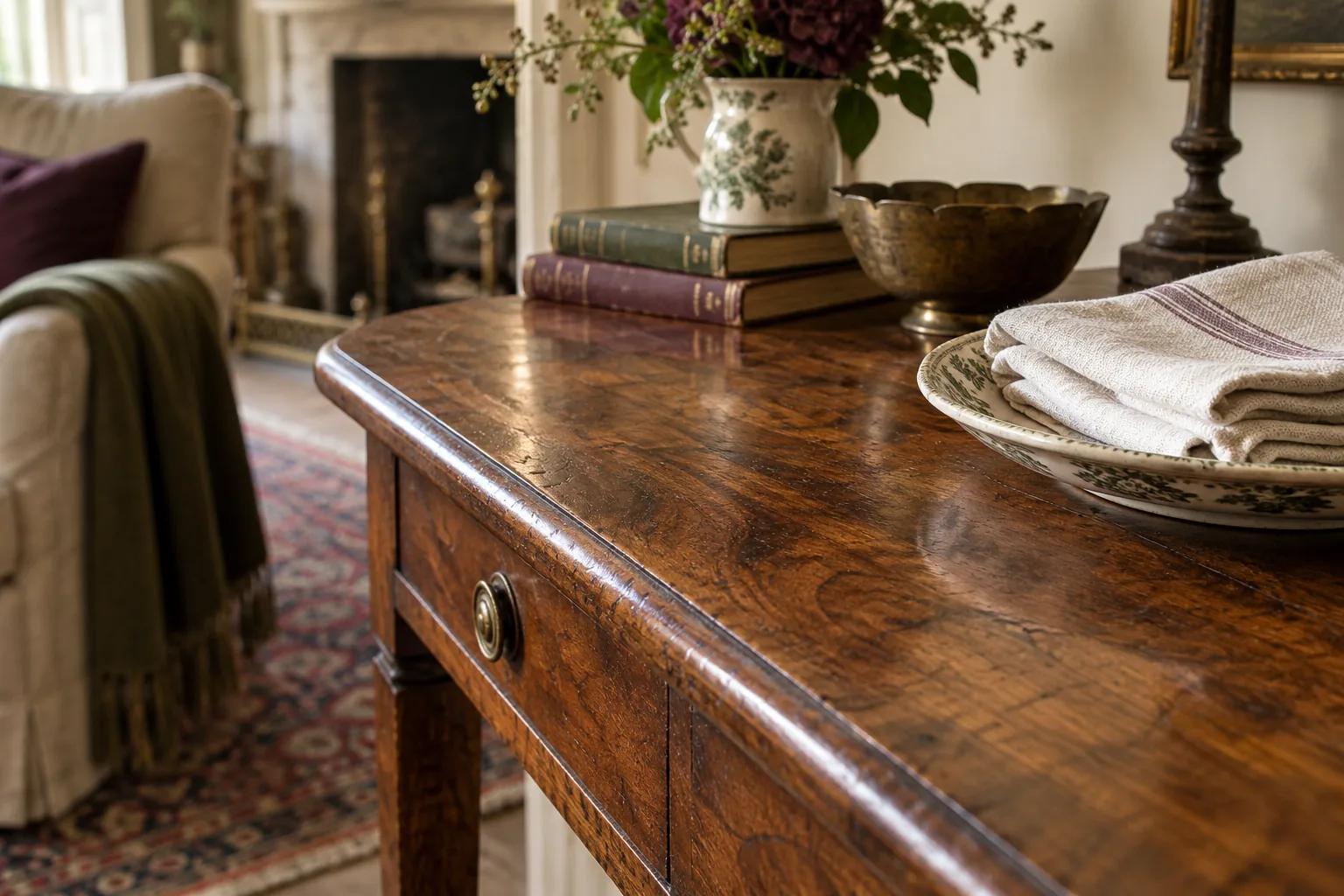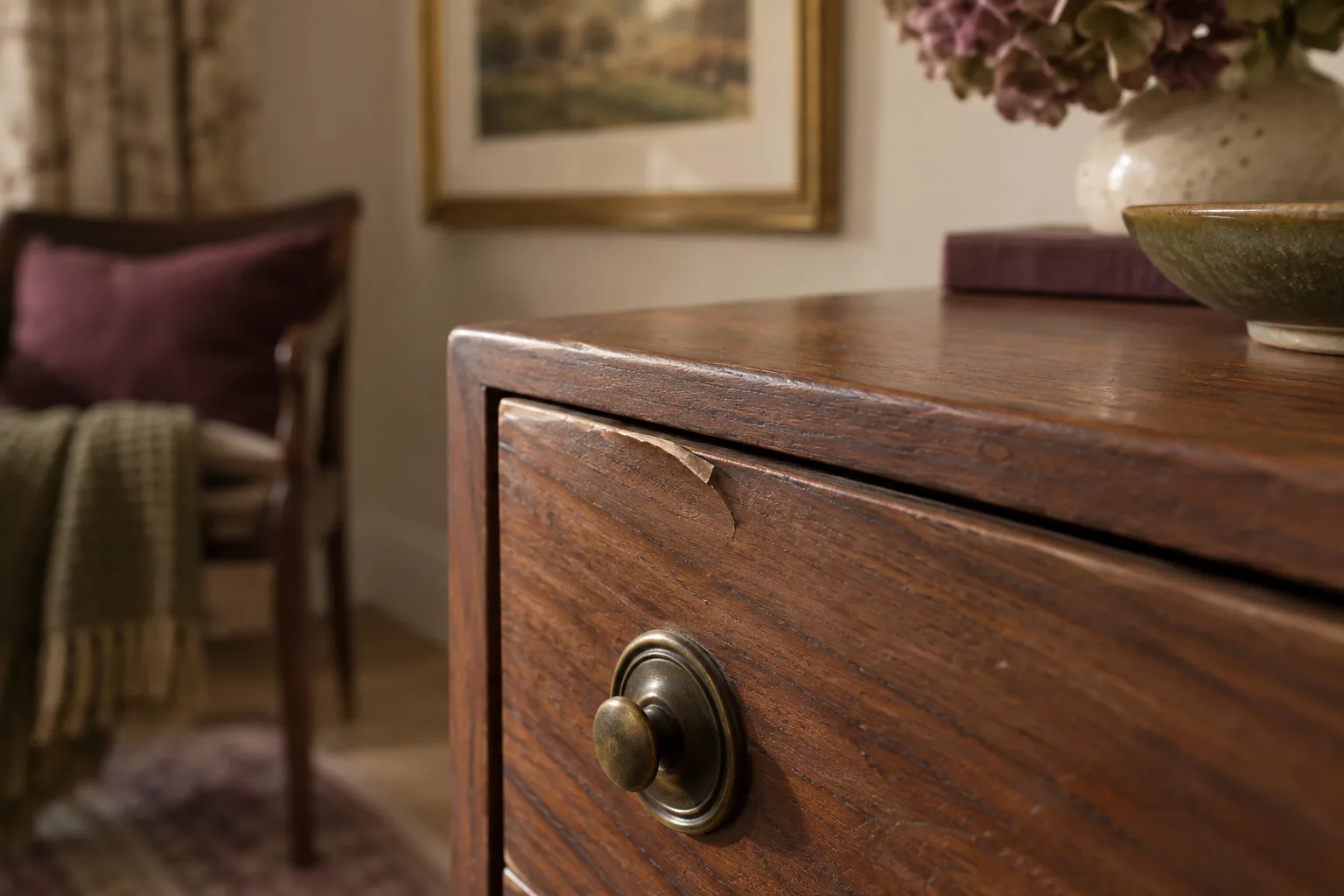
It often appears as a small inconvenience
The first sign may be a cloth catching at the corner of a cabinet or a line that looks slightly raised in the light. It is tempting to press it down and continue. A better response is to stop touching the area and look carefully without lifting or probing it. A small visible change does not reveal how far the problem extends beneath the surface.
Move everyday activity away from the affected area where practical. If the top usually holds a tray or receives keys, find another place for them. Do not balance a heavy object over the loose section in the hope that pressure will settle it. A household workaround can complicate the eventual treatment.
Make a record before doing anything else
Take an overall photograph showing where the area sits on the piece, followed by a closer view. Include a separate ruler nearby if scale is helpful, without resting it on the fragile section. Use light that shows the raised edge clearly. Several useful photographs are better than repeatedly touching the surface to explain what it feels like.
Write down when you first noticed it and anything relevant about recent movement, cleaning or changes in the room. Be honest about products already used. A conservator needs that information to understand the situation, and a previous attempt is more useful as a documented fact than as something omitted out of embarrassment.
Leave the choice of treatment open
Do not add household glue, tape, heat or moisture. Those are interventions whose suitability depends on materials and condition you may not be able to identify. Even a product described as reversible needs to be evaluated in the context of the actual furniture. The goal at this stage is to preserve options for someone able to assess it.
The Canadian Conservation Institute's guidance on furniture finishes emphasises understanding the coating and its condition before treatment. A loose decorative surface brings similar reasons for caution: the visible timber, adhesive, underlying structure and finish may all be involved. A repair should respond to that combination rather than just make the raised line disappear.
Keep detached pieces with the object
If a fragment comes away, do not discard it or try to fit it repeatedly into the gap. Put it somewhere protected, clearly associated with the furniture, and ask the conservator how best to store or transport it. Include a photograph and note where it was found. Even a small piece may provide useful information or be suitable for reinstatement.
Keep packaging labels separate from the fragment itself. Do not write directly on it or stick tape to its surface. If several fragments are present, avoid a loose pile where edges rub together. A professional can advise on an appropriate temporary arrangement for their condition and size.
Ask for an assessment that includes use
Explain whether the piece is a daily dining table, a lightly used cabinet or primarily a display object. That intended use matters when discussing treatment and future care. Ask what can be established from photographs, whether an in-person examination is needed and whether the furniture should remain unused in the meantime.
Once the area has been assessed, discuss the surrounding routine as well as the repair. A change to placement, handling or the objects kept on top may be sensible. The aim is not necessarily an invisible result at any cost. It is a stable, understood surface that can continue in an appropriate role, with the original material retained wherever a considered treatment allows.