Look at the room in winter
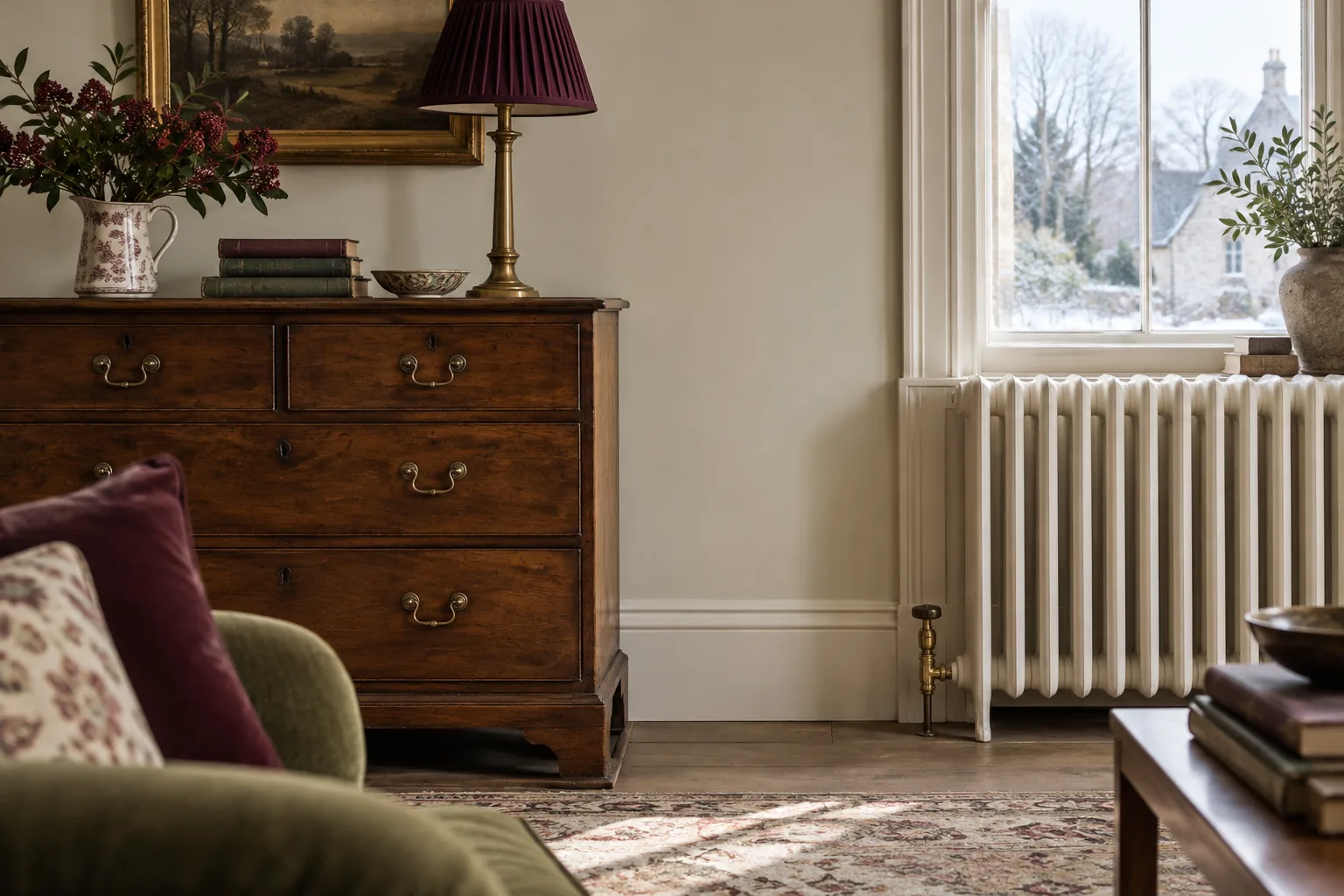
A cabinet often finds its place during a tidy-up, when an empty strip of wall appears to solve everything. In summer, the radiator beside it may barely register. Once the heating returns, that apparently quiet position becomes a different environment. Walk around the room with its ordinary winter use in mind before deciding a piece has found its permanent home.
Include fireplaces, warm pipes, vents and portable heaters in that review. You are not trying to turn the sitting room into a laboratory. You are identifying obvious conditions that could make an alternative position more sensible. A small change made before problems appear is easier than a repair arranged after the surface has changed.
Why position belongs in a care plan
The Canadian Conservation Institute advises keeping wooden furniture away from direct heat sources and avoiding unstable environmental conditions. Wood responds to changes in moisture, so an old cabinet's surroundings matter alongside its visible condition. A bottle of furniture treatment is not a substitute for choosing a more suitable place.
That advice does not produce a universal safe distance for every radiator and every object. Heat output, room layout, materials and condition vary. If a valuable or vulnerable piece has limited placement options, ask a conservator to assess the situation rather than adopting an arbitrary gap as a guarantee.
Compare the alternatives
Start with the simplest relocation. Could the cabinet move to the opposite wall while a less sensitive, appropriately chosen object occupies the original gap? Would turning the seating arrangement free another space? A room plan with furniture footprints can make these options easier to compare than repeatedly moving heavy pieces.
Consider other consequences at the same time. A new position should not block ventilation, narrow an exit or put the cabinet directly in strong sunlight. Keep heating equipment clear according to its own safety instructions. Care for an object is only one part of making the room work safely and comfortably for the people in it.
Observe without experimenting
If you notice a drawer becoming difficult, a new gap or a surface change, record when it appeared and what else changed in the room. Do not force the drawer or immediately apply a product. The timing may help a professional understand the problem, but it does not prove that heat is the only cause.
Photographs taken from the same viewpoint can be useful, especially when you are unsure whether a line was present before. Keep them with basic notes about the furniture and any previous work. Avoid dramatic changes intended to reverse the problem quickly. Obtain advice appropriate to the object and address building or heating concerns with the relevant professional.
Make the arrangement practical
A care plan that depends on remembering to move a heavy chest every time the heating comes on is unlikely to remain convenient. Seek a position that works throughout the year. If seasonal movement is unavoidable, arrange suitable handling and keep the route simple. Repeated improvised moves introduce their own problems.
Once the piece is settled, review nearby additions occasionally. A new lamp, heater or rearranged curtain can change the conditions without anybody thinking of it as a furniture decision. The useful habit is modest: notice the surroundings as well as the object. Often the most effective care happens through room planning, before a cloth, polish or repair tool is ever considered.