Organise by the physical book for a moment
Most readers arrange books by subject, author or the order in which they hope to read them. Before returning to that system, consider their physical differences. A tall illustrated volume, a thin paperback and a fragile old binding do not necessarily belong in the same tightly packed row. Size and condition can guide a few useful exceptions.
Set aside any book with loose parts or obvious damage for advice rather than forcing it into the finished arrangement. Photograph the problem and keep detached material associated with the volume. Do not repair a binding with household tape simply to make it easier to shelve.
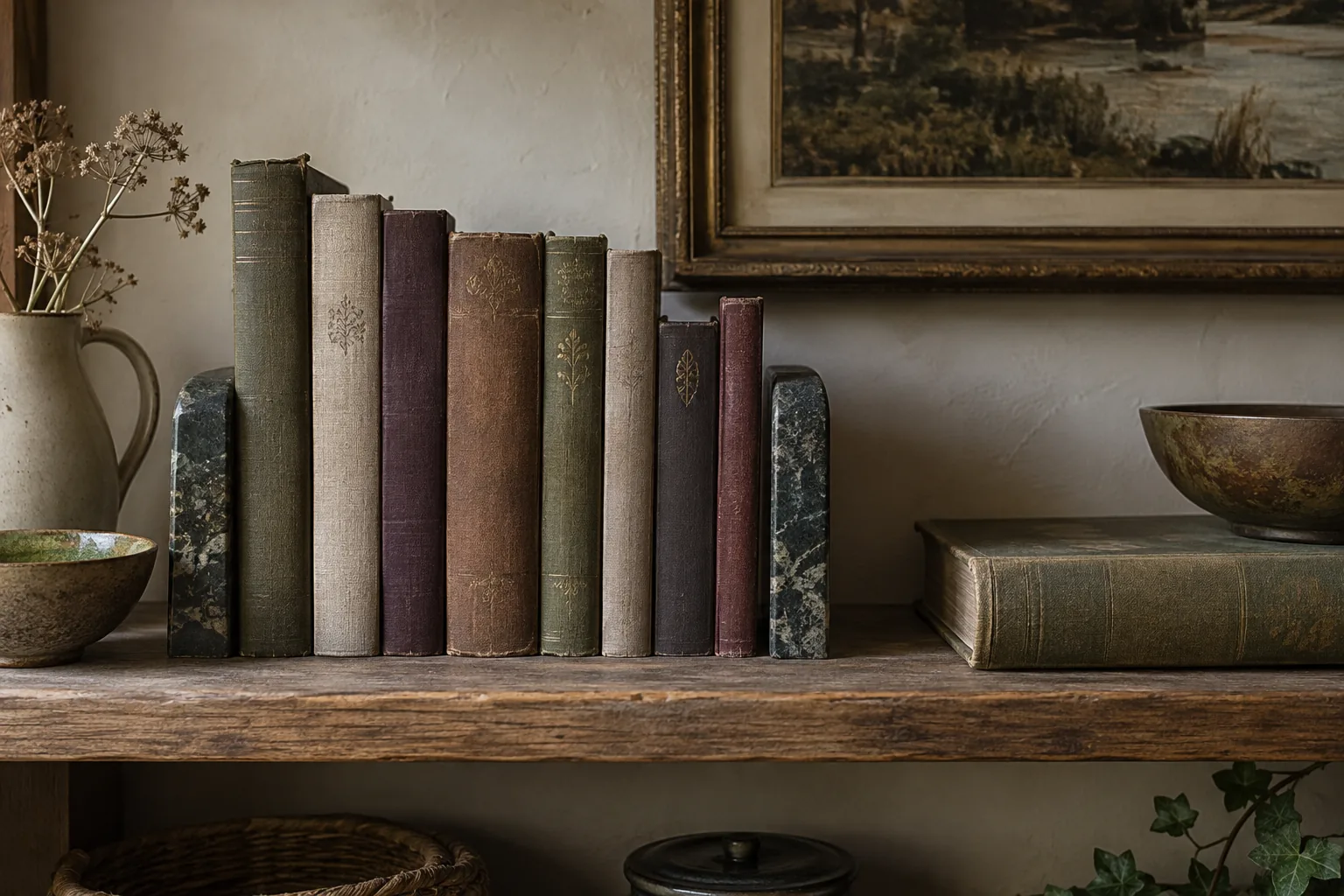
Support the row without compressing it
The Canadian Conservation Institute recommends supporting upright books and avoiding shelves packed so tightly that removal becomes difficult. It also advises storing large volumes flat with limited stacking. Those principles are useful in a home library, provided the shelf itself is suitable for the weight and the arrangement remains accessible.
Choose bookends that work with the size of the books and do not introduce sharp or abrasive contact. An attractive ornament is not automatically a reliable support. Leave enough room to grasp a volume sensibly, but not such a large gap that the row collapses into a steep lean whenever a book is removed.
Consider where a regularly borrowed book will go while you read it. If taking it out leaves several neighbours unsupported, the arrangement needs a more flexible solution. A shelf should tolerate normal use rather than remain stable only when every item is present in exactly the right order.
Change the way you take a book down
Avoid pulling a volume out by hooking a finger over the top of its spine. The CCI's guidance describes safer ways to gain access to the body of the book and support it during removal. For an unusually fragile or large volume, ask a book conservator to demonstrate suitable handling rather than improvising.
Prepare a clear reading surface before lifting a heavy book. Keep drinks and food elsewhere, and do not assume an old binding will open flat. Support requirements vary. If the book resists opening comfortably, respect that limit and obtain advice about viewing or photographing it without placing stress on the structure.
Make the less convenient books easier to find
Flat-stored volumes can disappear beneath other things if their location is not recorded. A simple shelf list or a photograph in your phone can keep them part of the working collection. Do not compensate for poor visibility by attaching improvised labels directly to old bindings.
Think about frequency of use when assigning shelf height. The heavy reference book you consult weekly should not live in the most awkward position simply because it looks impressive there. Safe access and a suitable supporting surface are more valuable than a perfectly graduated display of spine heights.
If a fragile book is frequently consulted for one particular page, discuss a suitable digital copy or reproduction. That can preserve access to the information while reducing repeated handling of the original. The decision is especially useful for family recipes, inscriptions or illustrations that matter independently of the binding.
Give the shelf a periodic review
Check for new crowding, leaning and changes in condition as the collection grows. A shelf arranged comfortably a year ago may now be overloaded because every new purchase was fitted into the nearest gap. Reorganisation is a normal part of keeping books, not evidence that the original system failed.
Include the surroundings in the review: direct sunlight, heat sources, plumbing and difficult access can all influence where books are best kept. Valuable or vulnerable volumes deserve advice suited to their materials and history. An ordinary home library can still benefit from a modest aim: every book supported appropriately, every title findable and no removal requiring a tug, a climb or a collapsing row of neighbours.