Choose the whole outline
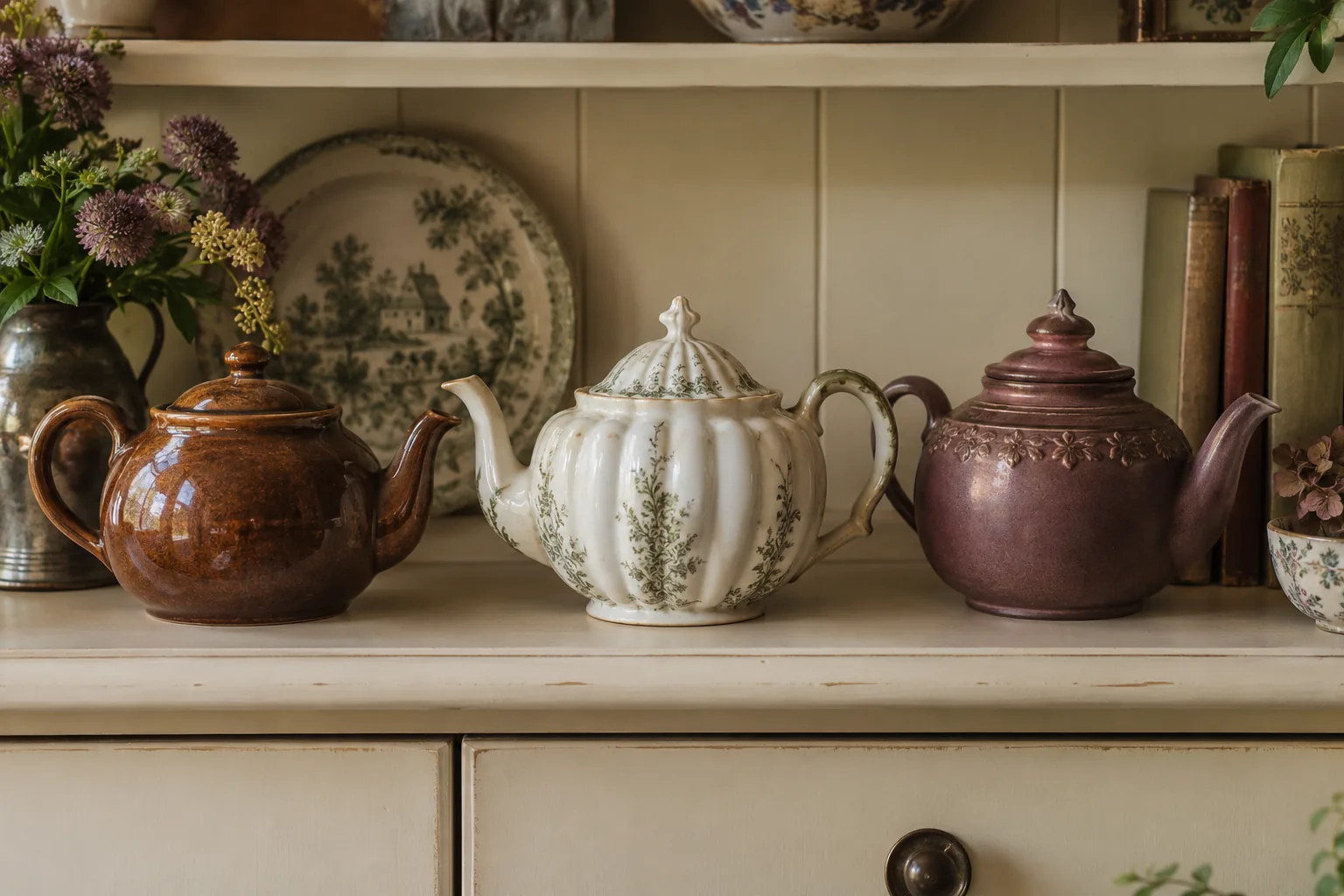
A teapot can be appealing long before you notice its decoration. A low rounded body and a tall angular handle might give it an almost comic character; a narrow spout can make an otherwise solid shape seem light. Look at the outline as a whole, rather than deciding from a close photograph of flowers or gilding.
If the teapot will sit on a shelf, consider which side will face the room. A design that continues around the body offers more freedom than a single decorated front. Ask to see both sides, the underside and the lid separately. Those ordinary views are often more useful than a carefully styled picture with a cup and folded napkin.
Give the lid proper attention
A lid that looks plausible may not be original to the pot. You do not need to become an authentication specialist to ask whether the seller believes the pieces belong together and what supports that view. Compare colour, decoration and fit, while accepting that photographs cannot settle every question.
Check for damage around the lid's rim and knob as well as the spout. Ask for close images of anything unclear. Do not dismiss a replacement or a missing lid automatically if you like the object, but make the decision with accurate information. A teapot bought as an incomplete decorative piece is a different proposition from one bought under an unsupported promise of completeness.
Allow space for its awkward shape
Spouts and handles extend beyond the body and are easily overlooked when measuring a shelf. Measure the full width and leave clearance for lifting. When moving a teapot, treat the loose lid as a separate part and support the body securely. Do not rely on an old handle to carry the object's weight.
Avoid a display position beside a frequently used cupboard or at the edge of a crowded desk. Teapots can look charming amongst books, but they should not need moving every time someone reaches for a novel. A dedicated patch of shelf with a calm background will usually show the shape more clearly and reduce unnecessary handling.
Do not let nostalgia decide food suitability
There is a distinction between a teapot you admire and one you can confidently use for brewing. An old vessel's appearance does not establish the safety of its materials, previous repairs or condition. If regular use is the goal, seek reliable confirmation of suitability rather than relying on a seller's phrase such as lovely for afternoon tea.
For an uncertain example, display it empty. There is no need to disguise that decision by filling it with dried stems or treating the lid as a miniature dish. It remains a complete visual object. Keeping a modern everyday teapot for serving also avoids turning a fragile collectible into something that must withstand repeated hot filling and washing.
Build a collection with a boundary
Teapots offer endless variety, which can make a collection expand faster than the available shelves. Choose a useful boundary: compact examples, plain glazes, unusual handle shapes or a particular colour family. A boundary helps you pass attractive pieces without feeling you have missed an obligation to collect them.
Record the dimensions and any condition issues alongside purchase details. Include a photograph with the lid removed so future damage is easier to spot. Revisit the display occasionally and show fewer pieces if their outlines start colliding. A small group whose individual characters remain visible often says more about your taste than a tightly packed parade of every teapot you have found.