Give the working day priority
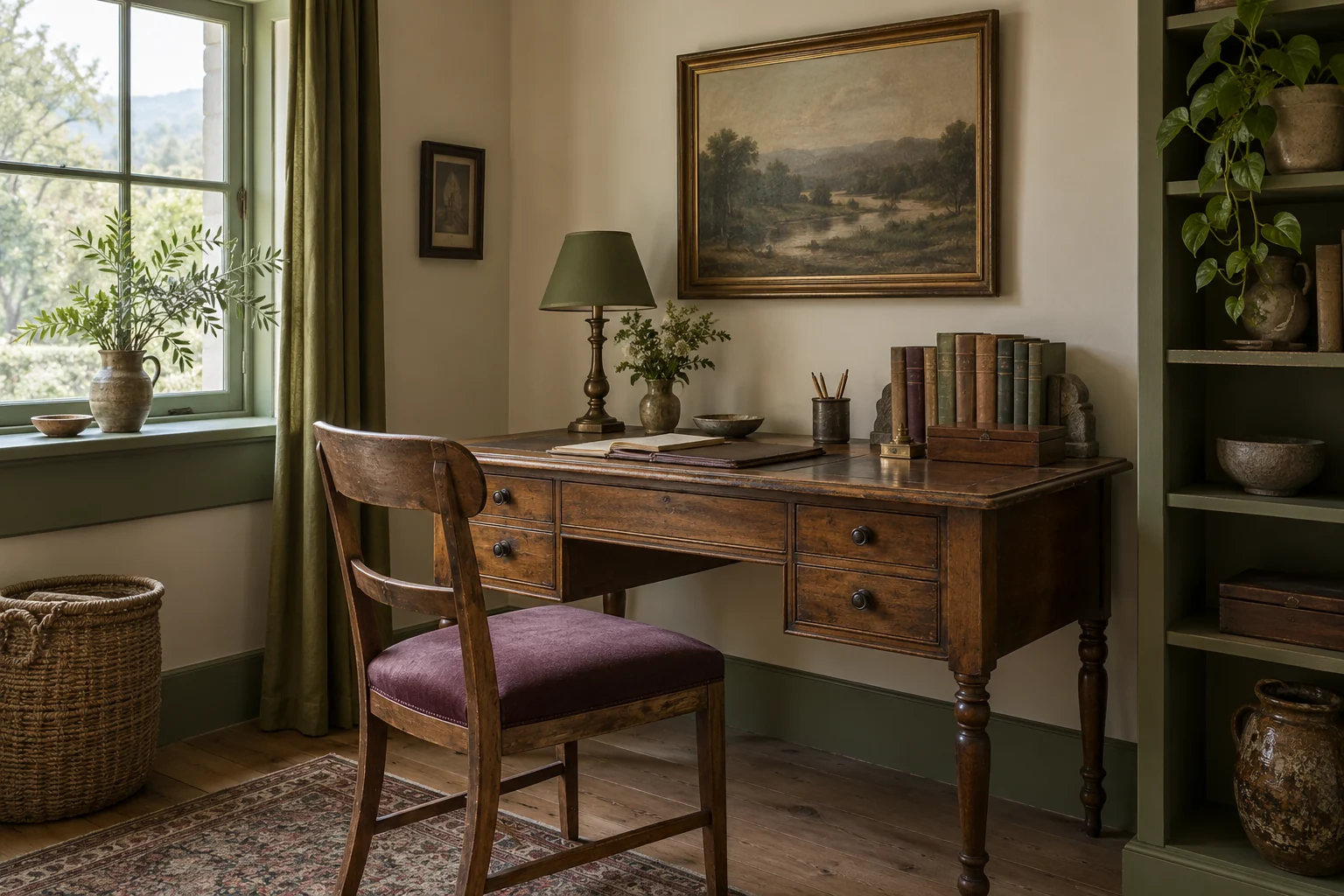
A charming writing desk may be perfect for correspondence and hopeless for a day involving a screen, keyboard and paperwork. Before building a home office around a vintage piece, lay out the equipment you actually use. Consider its depth, the room for your legs and whether the working height suits you with an appropriate chair. If the desk cannot support a comfortable setup, let another old piece provide the character. A bookcase, chest or side table can contribute just as much to the room without dictating how you sit for hours.
Make old and new look deliberate
Modern equipment does not need to be disguised as something antique. A straightforward monitor and a contemporary task chair can sit comfortably beside older timber when the surrounding arrangement is restrained. Repeat one or two colours through a folder, a picture or the chair upholstery to connect the elements. Avoid adding faux-period accessories purely to hide the practical nature of the space. An office is allowed to look like a place where work happens. The contrast between useful technology and a characterful cabinet can be more convincing than an attempted historical scene.
Separate working storage from display
Books, files and supplies have different needs from decorative objects. Put frequently used materials where you can reach them easily and keep heavier items on suitable lower shelves. Reserve a small, clearly defined area for things you like to look at. If every shelf mixes paperwork with fragile ceramics, both the work and the display become awkward to maintain. A cabinet with closed storage may be especially useful for visually noisy equipment, provided ventilation and access requirements are respected. The aim is to reduce unnecessary visual demands while keeping useful things straightforward to retrieve.
Choose a view for short pauses
Look up from your usual working position and notice what fills your view. A favourite print, a patch of clear wall or an interesting arrangement of books can make that moment more pleasant. It need not become a complex display. Keep highly personal or distracting material away from the immediate working area if it pulls your attention from tasks. Where video calls are common, check the background from the camera's actual angle. A low, stable arrangement and a little open space often appear calmer than shelves filled tightly from end to end.
Use textiles without complicating movement
A textile can soften an office that otherwise feels dominated by hard surfaces. Curtains, a cushion on a separate reading chair or a small wall textile may bring colour without interfering with desk use. If there is a rug, check how the chair moves over it and whether edges create a catching point. Avoid piling softness onto the working chair if it compromises its support or adjustment. Comfort in a workspace comes from how the arrangement functions, with decorative warmth added around that foundation rather than used as a substitute for it.
Give the room an end-of-day setting
When work shares space with domestic life, a brief reset can change the room's mood. Put current papers in one folder, return supplies to their place and clear the part of the desk visible from the rest of the room. A single object or closed notebook can remain without suggesting that every task is unfinished. There is no need to turn the office into a showroom each evening. A workable stopping point allows its older furniture and personal details to feel like part of your home again, rather than scenery behind a permanent working session.