Choose the pictures before the pattern
A picture wall is more satisfying when it begins with images you want to see. Gather the works you are considering and look for relationships in subject, colour, mood or scale. They do not need a single theme, but each should contribute something beyond filling an empty rectangle. A modest drawing can sit beside a larger photograph if the pairing feels interesting to you.
Set aside pieces that are present only because their dimensions are convenient. You can build the composition gradually. This guide concerns visual arrangement; suitable fixings, wall condition and the safe support of each frame require their own assessment.
Work with the wall's existing boundaries
Furniture below, door frames beside and the ceiling above all influence how a group of pictures reads. Consider the collection as one broad shape within those boundaries. A low, wide group may relate well to a sideboard, while a narrower arrangement can suit a vertical stretch of wall.
Lay the framed works on a clear floor to test combinations, protecting their surfaces and glass. Photographs of these trials can help you compare options without remembering every detail. Do not force the group into an exact rectangle if that makes the individual relationships awkward. A slightly irregular edge can feel natural when the overall balance is clear.
Give the differences a repeated thread
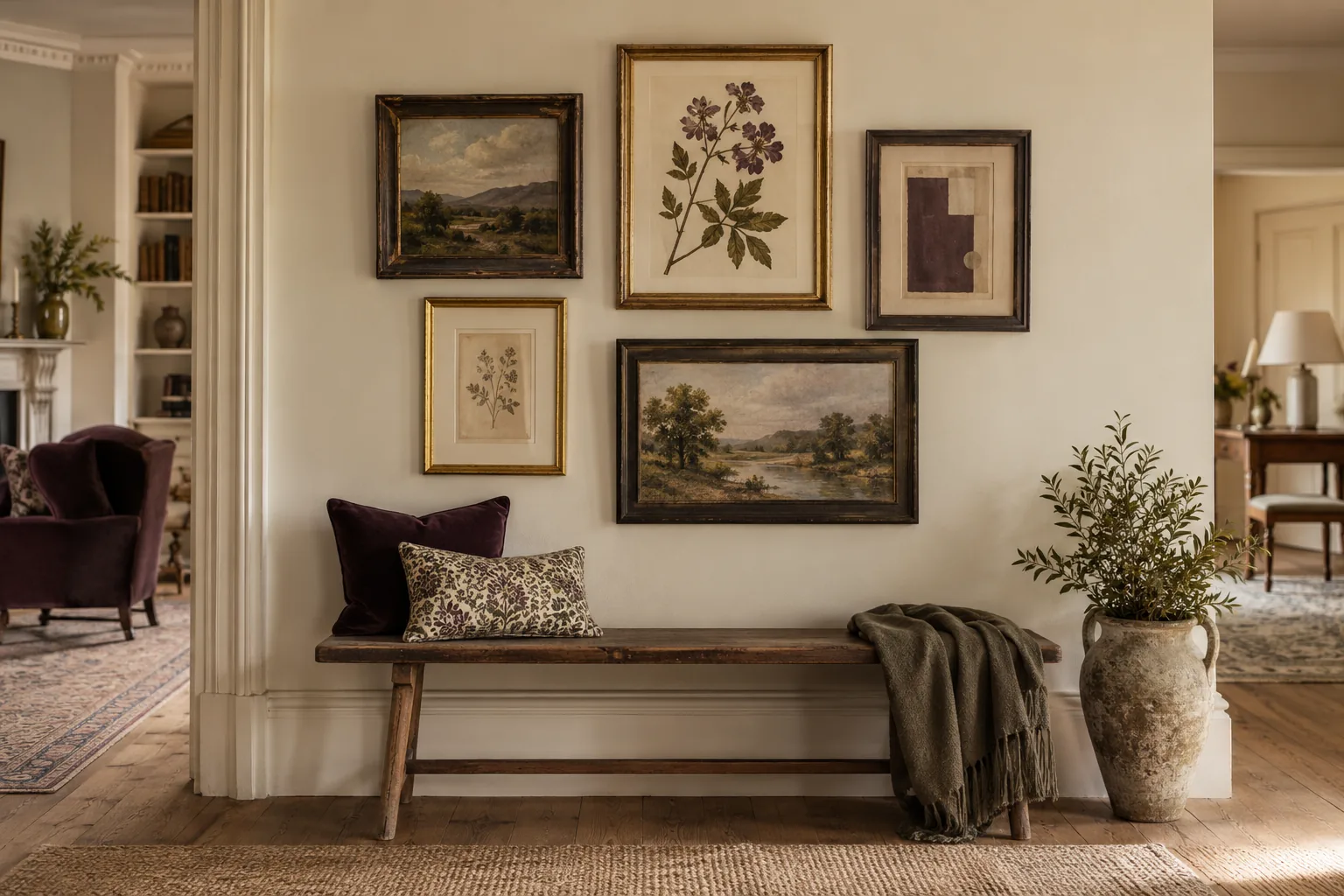
Mixed frames become easier to read when a material or colour returns a few times. Two dark frames, a pair of warm wooden ones or several pale mounts can establish a rhythm without requiring a matching set. Distribute these repetitions so that one side does not become much heavier than the other.
Look at the images as well as the frames. A dark photograph has more visual weight than a pale drawing of the same size. If the arrangement tilts to one side, moving an image may work better than replacing its frame. Some variation in spacing can suit irregular shapes, but accidental-looking gaps often benefit from a little more consistency.
Allow one work to lead
A larger or more assertive image can give the collection a centre of gravity, though it does not have to sit in the exact middle. Arrange a few companions around it and see where your eye travels. If every work is equally strong, a quieter image or a larger patch of wall between groups may provide relief.
Keep delicate or valuable works out of conditions that could damage them, including unsuitable sunlight or moisture. The most compositionally convenient position is not automatically the best place for the object. A picture wall should be enjoyable over time, not merely successful in the first photograph after it is arranged.
Try a group of five without forcing a centre
Suppose you have a large landscape, two small drawings, a dark photograph and a narrow vertical print. Start with the landscape slightly to one side of the intended group, then place the photograph where its darker tone balances that visual weight. The remaining pictures can connect the two rather than being assigned equal slots around them.
Look for distracting alignments. A tiny gap between two frame corners can seem accidental, while a repeated horizontal edge can quietly organise the group. You do not need every top and bottom to line up. Choose one or two relationships that are easy to read and let the others remain more relaxed.
Take a photograph of the floor arrangement, then make a second version with the strongest two images swapped. Comparing images side by side is more reliable than trying to remember the previous layout. If neither feels convincing, remove the narrow print and try again. Four works may make a better group than five; the omitted picture can have its own place elsewhere.
Before installing, transfer the outlines to paper templates on the wall using a method suitable for its finish. Check heights from a chair and the doorway. A composition that works on the floor still needs to relate to the room's actual furniture and sightlines.
Leave room for a future change
Before installation, check the proposed group from the main seats and the doorway. Ask whether individual pictures remain visible or disappear into an overpacked pattern. A collection can stop before every available space is used. Future additions are easier when the arrangement has a little flexibility at its edges.
Once the works are safely installed using suitable methods, resist adjusting the whole room to make the wall its only attraction. A chair, table or lamp nearby should still be allowed to function normally. The pictures are part of the room's life: they can reward attention without demanding that every surrounding surface become a carefully controlled extension of their composition.