Decide what sort of stool you need
Small stools are easy to bring home because they seem to promise usefulness everywhere. One could sit beside the bath, another might hold a book near the sofa, and a third could become an occasional seat. The difficulty is that those jobs make different demands. Before buying, choose the main purpose rather than relying on the vague idea that it will find a place.
For seating, comfort and sound construction lead. For a side surface, a level top and enough usable area may matter more. A step stool is a separate category: do not use an ordinary vintage seat as access equipment simply because it stands at a convenient height. The intended function needs to be established.
Measure the seat, not just the legs
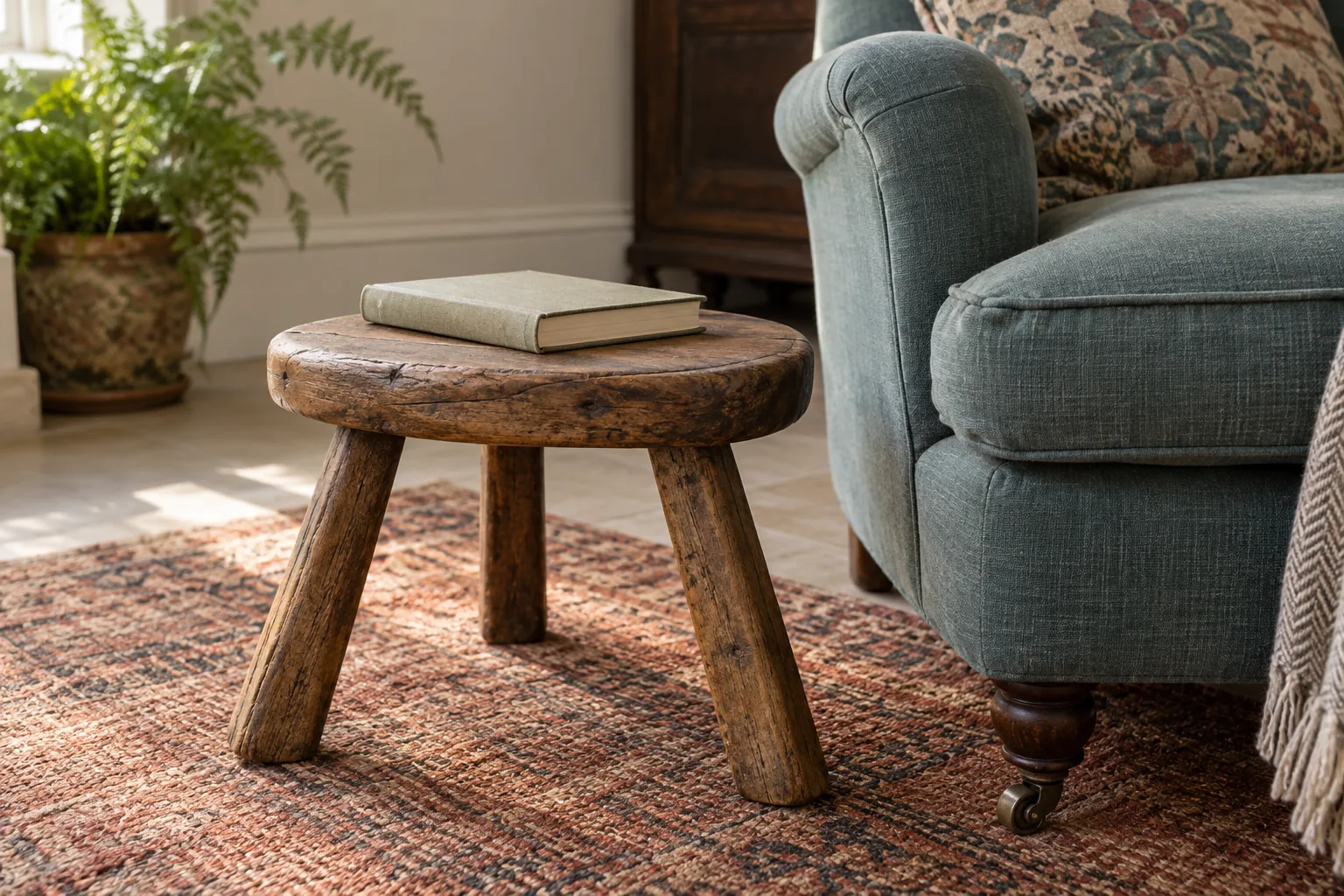
An oval, round or shaped seat may provide less usable area than its maximum width suggests. Set out the lamp, cup or book you hope to place there and compare their footprint. A dished seat designed for sitting can be awkward as a table. An appealing little stool is not necessarily a good substitute for a flat surface.
If it will be used at a dressing table, check the seat height against the space underneath. Leave room for your legs and consider where the stool goes when you stand up. A backless seat may tuck away neatly, but it may not be comfortable for the amount of time you intend to spend there.
Inspect all the connections
Look at the joints between legs, seat and any stretchers. Ask about movement, previous repairs and suitability for the intended use. A stool should not be tested aggressively to see what it can withstand. Visible damage or uncertainty calls for assessment by someone who understands the construction.
Check the underside as well as the attractive top. Labels, repaired areas and missing components may be easier to see there. A painted surface can conceal details, so do not assume an immaculate new coating establishes good condition. If the seller describes the piece as decorative, clarify that it is not being offered as reliable seating.
If the stool will hold a drink, try reaching towards an equivalent height from your usual chair. An attractive low surface can be inconvenient when its position requires leaning forward every time.
Give it a stable place in the room
A small stool can soften the space beside a large cabinet or introduce a lower level near an armchair. It works best when people can see it easily rather than encounter it unexpectedly in a walking route. Avoid placing it where a door will strike it or where it narrows the space beside a bed.
Let the material remain part of the attraction. A worn timber stool beside a smooth upholstered chair can create a pleasing difference without requiring matching accessories. If you use it for a plant, protect it from moisture and think carefully about the consequences of a spill; a separate purpose-made plant stand may be the better answer.
Try one job at a time once it arrives. Moving a small piece is easy, but constant reassignment can prevent it becoming useful anywhere. The right spot is usually the one where you find yourself reaching for it without thinking, whether to sit briefly, put down a book or bring an extra surface into a conversation.