Look at the surface as part of the design
The pattern on a cabinet front can be the reason you stop to look at it. A mirrored arrangement of grain, a dramatic curl or a quiet sequence across several doors can give otherwise simple furniture its character. Treat that surface as an important part of the object. The word veneer alone tells you little about how successfully a particular cabinet was made or how well it has survived.
Begin with an overall view. Do adjacent doors read as a coherent arrangement? Are there conspicuous differences in colour or pattern that might reflect repairs? Such differences are not necessarily unacceptable, but you should understand what you are buying rather than discovering an obvious patch after delivery.
Follow the edges
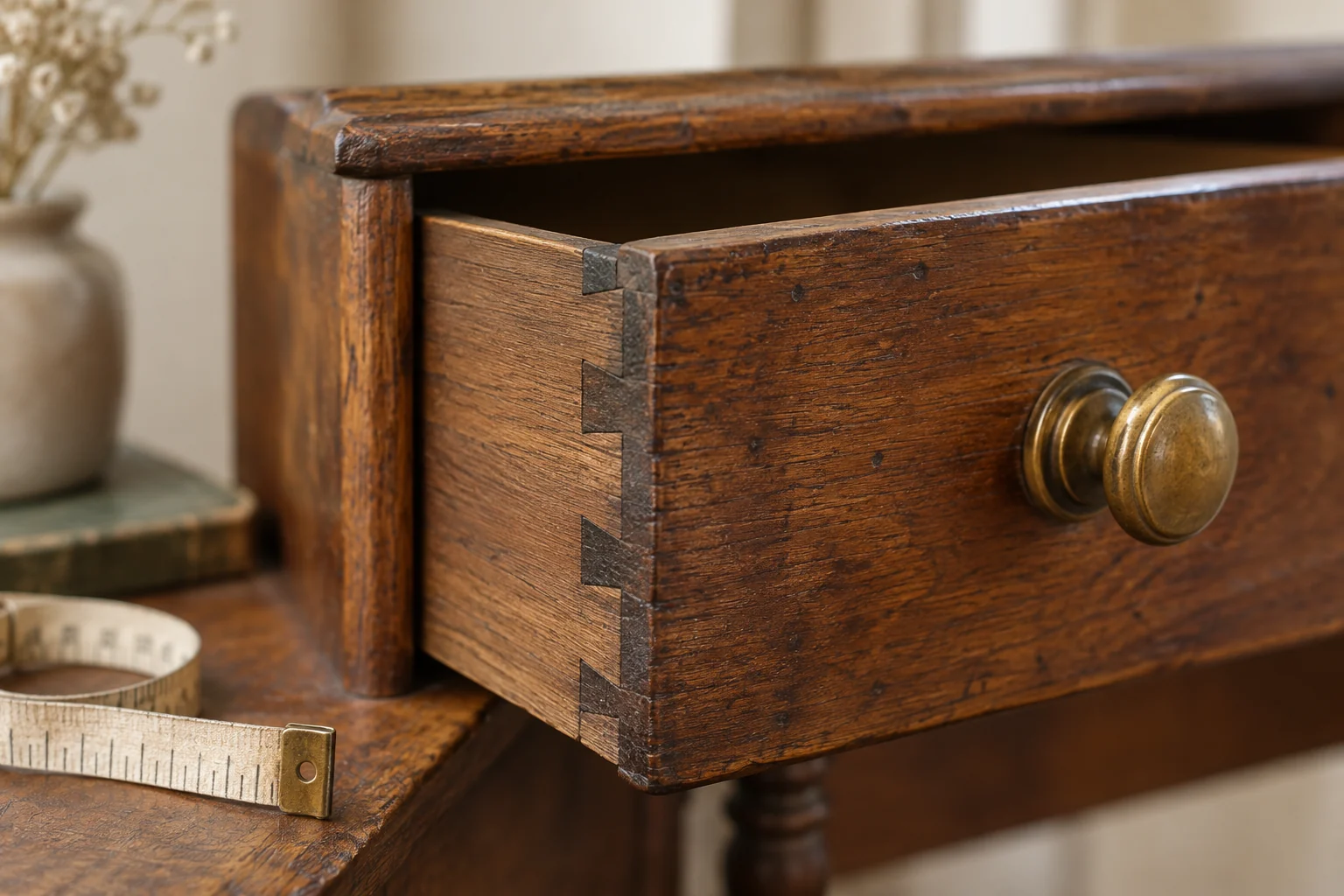
Ask for close photographs of corners, door edges and the places most often touched. Look for missing sections, raised edges and visible separations. Do not pull at a loose area or press it flat as a test. A small-looking defect can require more involved treatment than a photograph suggests, and casual handling can make it worse.
Inspect horizontal surfaces too. A top may have a different history from the front because it has carried lamps, vases or other objects. Request a view in light that reveals unevenness rather than only a flattering straight-on photograph. You want to distinguish a surface you happily accept from one that depends on uncertain repair work.
Ask what happened before the listing
A seller may know that a section was repaired, the surface refinished or a top replaced. Ask directly and keep the answer with the purchase details. If a cabinet is described as restored, find out what that means in this case. The term can cover very different amounts and types of intervention.
Do not assume sanding will remove a mark safely. Without knowing the material, its thickness and previous treatment, that proposed remedy is too vague to price or judge. A conservator or an appropriately experienced restorer can assess options. If the existing appearance bothers you, obtain that advice before buying rather than treating a future transformation as guaranteed.
Compare a discreet flaw with a central one
Imagine two cabinets with similar asking prices. One has a small loss near the lower rear edge; the other has a repair across the centre of a strongly patterned door. Even if both are described as structurally sound, the visual effect is different. The first may hardly enter your usual view, while the second interrupts the feature that attracted you.
Ask for a photograph from a normal standing distance as well as a close-up. Detail photographs are essential for understanding condition, but they can make a tiny blemish seem like the whole object. Conversely, a distant image may conceal a patch you would notice whenever you walk past. You need both views to judge your own response.
If repair is proposed, explain the result you hope for and ask what can realistically be achieved. A specialist's assessment should inform the decision before purchase. You may prefer an honest visible imperfection to a costly intervention whose appearance remains uncertain.
Consider where the cabinet will live
The Canadian Conservation Institute explains that changes in moisture can make wood move and damage furniture surfaces. It also identifies light and careless handling as important causes of deterioration. That is a reason to think about the cabinet's position from the beginning, particularly if its decorative surface is the feature you most enjoy.
Choose a location away from obvious extremes such as direct heat and persistent damp. For cleaning, avoid experimenting with household mixtures on an unfamiliar finish; seek advice suited to its condition. Everyday care should support the surface you bought rather than gradually replace it with a different sheen.
Finally, be honest about your tolerance for visible age. A small, stable loss at a discreet corner may be acceptable to you, while a large mismatched repair across the centre may not. There is no need to describe every defect as charming. Choose the cabinet whose present condition you understand, whose remaining work you have priced and whose pattern still gives you pleasure when you step back.