Look under the apparent openness
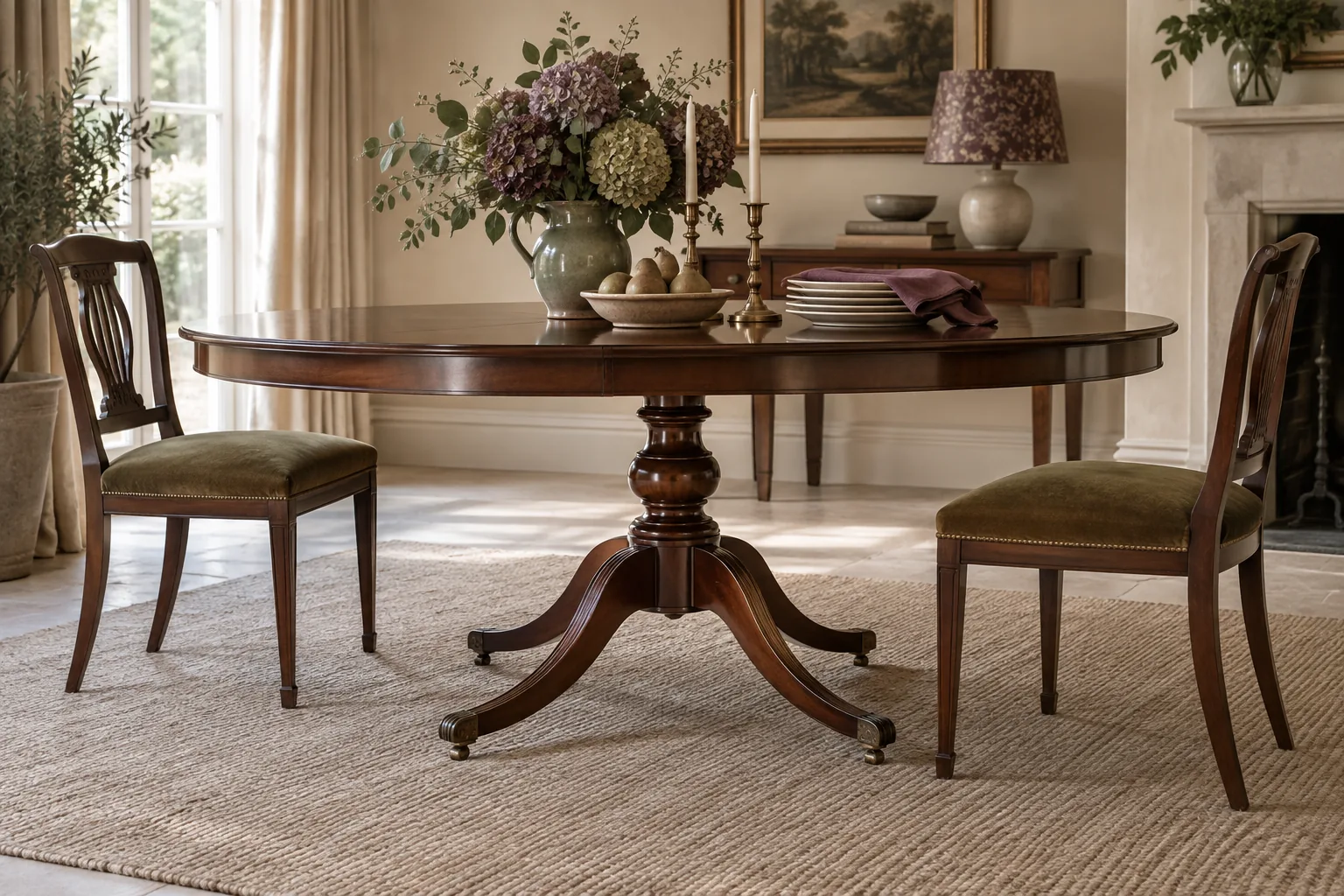
A pedestal table can seem to solve the familiar problem of dining-table legs arriving exactly where someone wants to sit. Moving the support towards the centre does open the edges, but the base still occupies space. Its feet may project widely, and its shape can affect where chairs and people fit. Start with photographs that show the complete base.
Measure the widest spread of the feet as well as the tabletop. Compare this with your chairs, especially if they have stretchers or broad front legs. The tabletop diameter alone cannot describe the seating arrangement. A graceful base in an empty room may become surprisingly busy once several pairs of feet gather around it.
Choose capacity honestly
A round table encourages an easy relationship between diners because there is no obvious head position. Its capacity still depends on the chairs, place settings and the people using them. Mark the proposed top on the floor or use paper to represent place settings on an existing surface. Include serving dishes if you prefer to keep them on the table.
Do not choose the maximum advertised number of seats as your everyday target without checking comfort. A table that accommodates occasional extra guests may feel crowded when used that way routinely. If you often need more space, investigate whether the particular design extends and what happens to the support arrangement when it does.
Inspect the connection between top and base
Ask about movement, repairs and the way the top attaches to the pedestal. Do not lean heavily on the edge to test stability. A competent furniture professional should assess doubtful construction or unexplained movement. If the top has a tilting mechanism, request a demonstration and confirmation that all locking components are present and functioning.
Look at the feet and the points where they join the central support. Repairs here may affect ordinary use even when they are hard to see from above. Ask for clear photographs and a direct condition description. The beauty of the central form should not distract from the parts doing the supporting.
If extension leaves are included, ask to see every one installed. Also identify where they will be stored, since a leaf without a suitable home becomes an awkward extra possession.
Place the circle within the room
A round top can make movement around a small dining area feel easier, but it still needs sufficient surrounding space for chairs to be pulled out. Measure from the widest point in every direction, including towards a sideboard or doorway. An oval or extending version introduces a different footprint that should be marked separately.
Consider lighting and nearby furniture as a group. A pendant centred above the table may work well, but the table's position should be determined by comfortable use before the light fixes it in place. A rectangular rug can sit beneath a round table successfully if its dimensions accommodate the chairs in use; matching shapes are not obligatory.
Finally, compare the table with the chairs from a low viewpoint. Heavy chairs around an elaborate pedestal may conceal the feature you liked most. Simpler seating can leave the base visible and reduce visual competition. The best pairing gives everyone enough room and allows the table's shape to be appreciated without demanding attention at every meal.