Begin with a reason for the mix
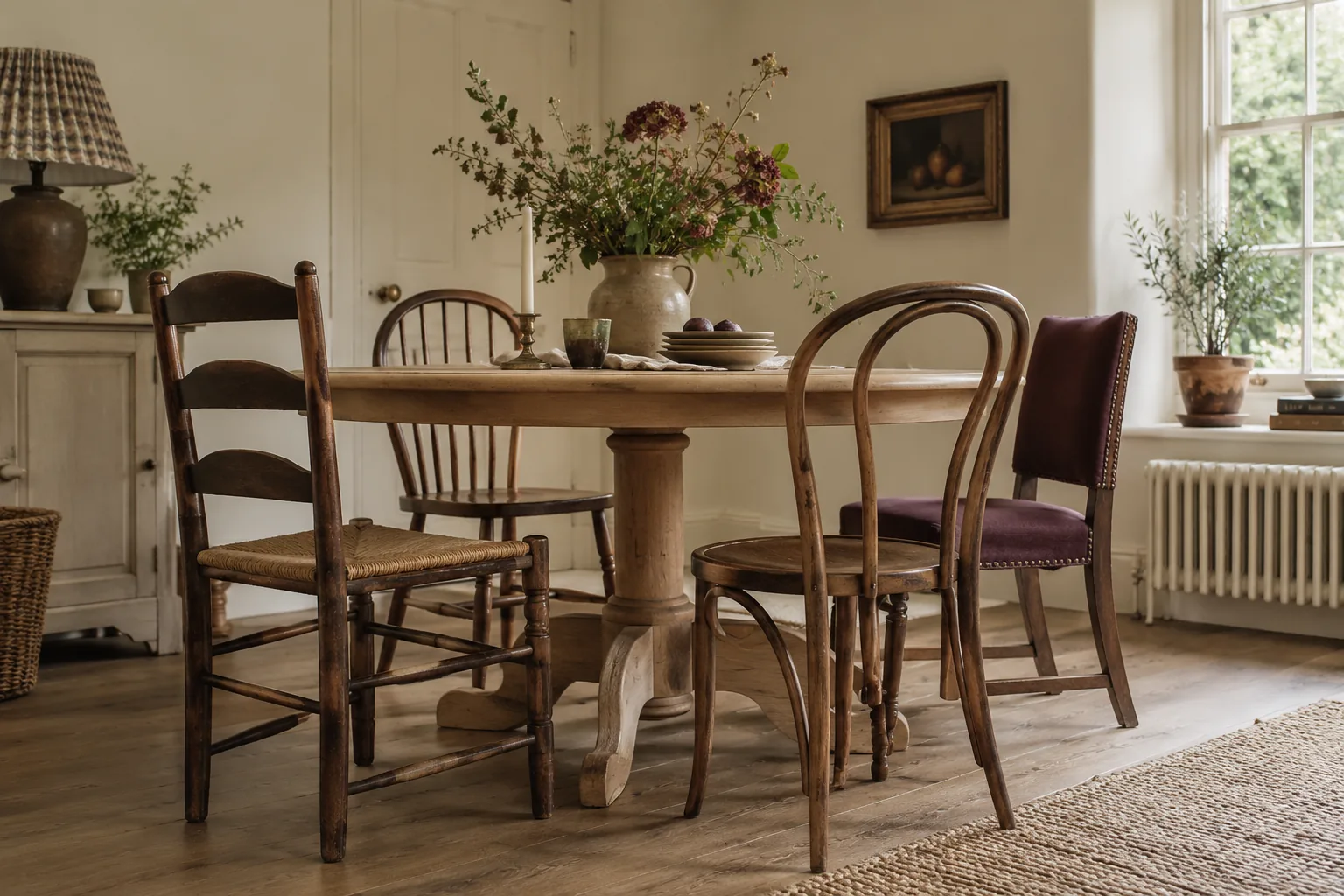
A mixed group of dining chairs can feel welcoming because it suggests a room assembled gradually. It can also feel restless if every chair competes for attention. The difference is often a simple organising decision. Perhaps you want different shapes in similar colours, or a repeated shape with several finishes. Choose one idea before buying the first appealing odd chair.
Start with any chairs you already own and enjoy using. There is no need to replace a sound pair merely to create a more photogenic collection. They can become the anchor for the group. Photograph them beside the table and note their dimensions so that later additions are compared with something concrete.
Agree on the practical essentials
Seat heights should work comfortably with the same table, even if the backs vary. Check the clearance beneath the apron and compare widths at their broadest points. A broad armchair can look excellent at the end while leaving insufficient space for the person beside it. The arrangement must work with people seated, not only with chairs pushed neatly in.
Comfort does not have to be identical, but none of the chairs should feel like a penalty seat. If one is conspicuously low, cramped or unstable, do not keep it solely for its appearance. Use it elsewhere if appropriate, or leave it out of the group. Guests should not need to negotiate for the usable chairs.
Try pairs before complete variety
Pairs provide a useful middle ground between a matching set and six unrelated pieces. Two chairs at each side and a different pair at the ends can establish rhythm without requiring uniformity. Another option is a largely matching group with one deliberate exception, provided the seating arrangement still feels balanced.
Back heights influence the view across the table. Place photographs in the intended order, or move the chairs physically if you have them available. A tall back at one side can draw attention away from the rest of the room. That may be welcome, but it should be a choice rather than a surprise after everything is delivered.
Check how the group looks from the doorway as well as from the table. That longer view often reveals an imbalance that disappears when you stand close.
Find connection outside the chairs
A plain table, restrained table linen or a rug with a quiet pattern can give varied chairs a common setting. You do not have to paint every frame the same colour. In fact, doing so may erase the surface differences that made the group interesting. Try the arrangement with its existing finishes before considering any alteration.
Keep cushions selective. Matching pads can create unity, but only when they fit each seat properly and improve comfort. A pad hanging over the edges of one chair draws attention to the mismatch in an unhelpful way. Some seats may be better left bare.
Allow the collection to develop slowly. A complete room is not necessarily a finished room, and waiting for a suitable fourth or sixth chair can produce a more convincing result than buying an almost-right one. Set aside the expectation that every piece must be individually remarkable. Sometimes the quietest chair is the one that helps all the others sit comfortably together.