Start outside
The piece fits the room. That is encouraging, but it is only the final part of the journey. Furniture also has to pass gates, steps, communal entrances and the turn beside the front door. Walk the complete route before buying a large item, beginning where the delivery vehicle can realistically stop.
Note anything that affects handling: uneven paths, narrow gates, low branches, steps or restricted access through a shared building. Photographs help a delivery company understand the situation, especially when a measurement does not capture an awkward angle. Ask about parking and access arrangements early enough to resolve them without a hurried conversation on delivery day.
Record the object accurately
Request maximum width, depth and height, including projecting handles, feet and cornices. For irregular shapes, ask for additional measurements and photographs from several sides. A single advertised width may exclude exactly the feature that catches at a doorway. Keep the seller's measurements in writing with the purchase details.
Find out which components can be removed safely and who will remove them. A cabinet may have a separate top, but it should not be assumed to dismantle because a similar piece does. Obtain dimensions for the largest remaining component. If disassembly requires specialist knowledge, arrange that work rather than expecting the delivery team to improvise.
Look at turns and clear height
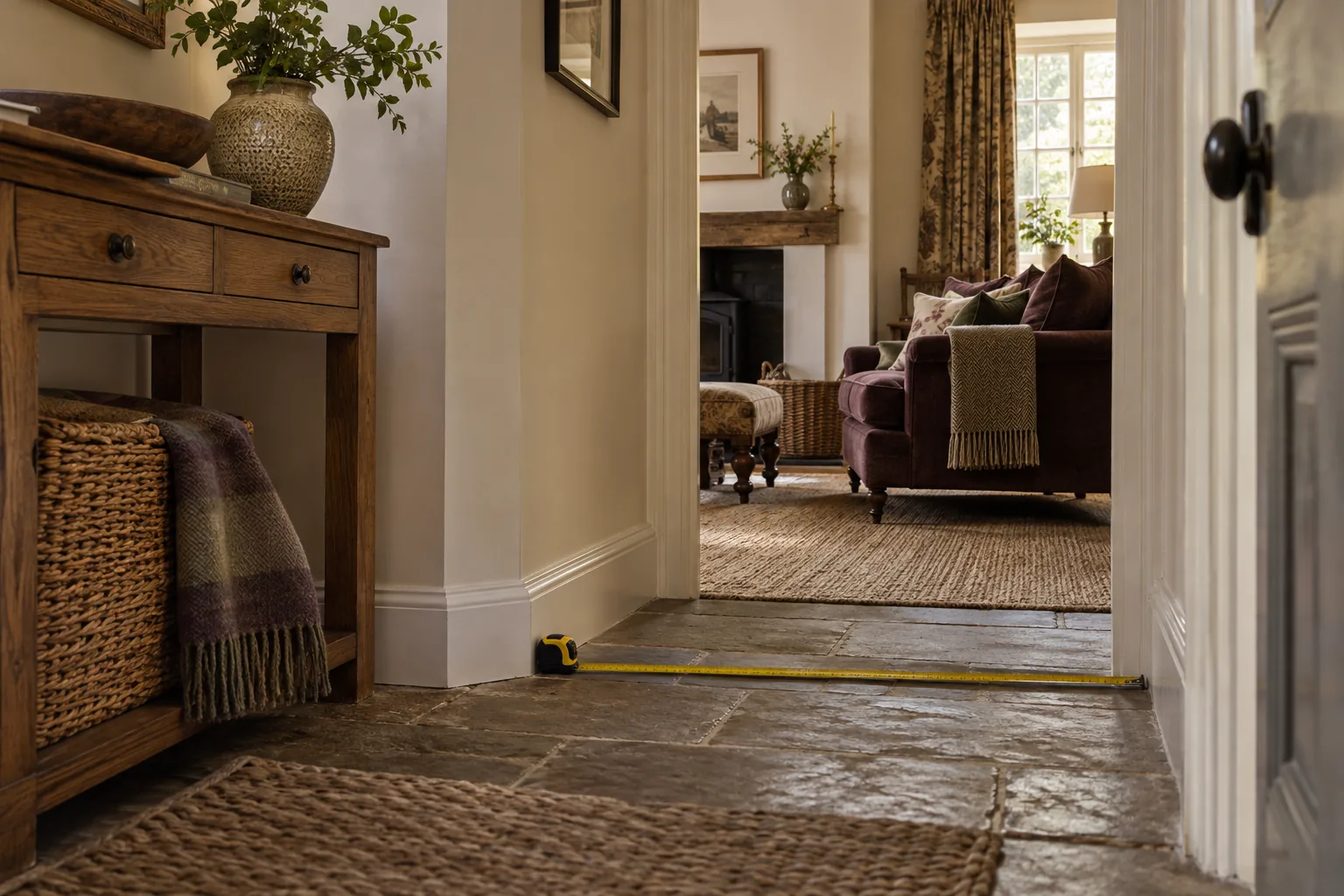
Door width is only one constraint. A piece may pass through an opening but have nowhere to turn immediately afterwards. Record nearby walls, radiators, banisters and ceiling changes. Staircases introduce further questions about angle and handling space, so provide clear photographs rather than trying to reduce the whole route to one reassuring number.
Do not rely on a simple diagonal calculation as proof that furniture will fit. Real handling involves thickness, protrusions, people and surfaces that cannot be ignored. Where clearance is close, ask the delivery company to assess access. It is better to receive a cautious answer before purchase than an uncertain experiment with a cabinet in the stairwell.
Give the carrier a useful access brief
A short access brief is easier to assess than a chain of reassuring messages. Put the item dimensions, delivery address, destination floor and any removable components together. Add photographs in the order the carrier will encounter the route: outside approach, entrance, turns, stairs and final doorway. Identify the tightest points rather than photographing only the spacious ones.
Where a door opens into a narrow corridor, include a view showing both the opening and the space beyond it. For a staircase, show landings, ceiling changes and fixed fittings. Explain which apparent obstacles are movable and which are not. A radiator, built-in cupboard or shared fire door should not disappear from the plan because removing it would make the measurements work.
Tell the carrier about shared-building arrangements before booking. Access times, lift dimensions and any booking requirements may affect the service. Confirm those details with the relevant building contact rather than assuming a delivery van can wait wherever convenient. The aim is a workable agreed plan, not a last-minute negotiation on the pavement.
Keep the brief with the written delivery agreement. If the seller subsequently says a projecting part cannot be removed, or the item measurements change, ask the carrier to reassess rather than relying on the earlier answer. A clear record reduces misunderstanding and gives everyone the same information. It cannot guarantee a difficult move, but it makes the decision considerably more informed than a doorway width quoted in isolation.
Agree on the service
Confirm whether delivery means the pavement, the entrance or the intended room. Ask about stairs, assembly, packaging removal and the handling of detachable parts. These are separate services in many arrangements, and assumptions can leave you with a large object in the wrong place. Clarify the plan with both seller and transporter.
Discuss what happens if access proves impossible despite the information provided. Understand the practical arrangements for return, storage or a revised delivery before the item leaves the seller. This is particularly useful when buying at a distance, where a second journey may be difficult to organise.
Prepare the last few metres
Clear the route and protect surrounding surfaces using arrangements agreed with the delivery team. Remove small furniture, loose rugs and decorative objects that could become obstacles. Keep children and pets away from the moving route. Do not attempt to help with heavy lifting unless the team has specifically agreed how that will work safely.
Inspect the delivered piece with the paperwork and photographs available, noting any concerns promptly. Keep removable fittings together and make sure doors, shelves or drawers are reinstalled appropriately before use. The reward for all this unglamorous preparation is simple: the furniture reaches its place, the room remains intact and you can spend the rest of the day deciding where the lamp should go.